
Decision Graph: Why Did a 4:12 p.m. Order Go to a Third Party?
Your CFO wants to know why an order went to a third party. Here’s the record that answers it.
Key Takeaways
1. When an order goes to a third party, the reason belongs in writing. A Decision Ledger entry records what the system knew, every option it priced, who made the call, and what happened.
2. In Burq’s sample 4:12 p.m. entry, the store’s own van kept a 5:15 promise for $11.90, beating third-party quotes of $12.75 and $13.40.
3. A third party wins when your van can’t make the promise inside its shift, the item needs a vehicle you don’t run, a contract owes a provider volume, a provider keeps the promise for less, or your own team sends it there.
4. Each entry is sealed the moment the call is made and graded on what was known then, so a lucky outcome can’t pass for a good decision.
5. Graded results feed the decision graph, the evidence behind the next call. That loop is what decision intelligence means in practice.
Sooner or later, somebody asks why an order went to a third party. Usually it’s the CFO, holding a delivery bill from a week when your vans ran half-empty. Sometimes it’s a store manager who watched a gig driver pull away while your own van idled in the lot. Either way, “the system picked it” is a shrug with a login.
A real answer takes two records. Burq’s Decision Graph is the long memory: how every provider and every one of your vans has actually performed, by zone, hour, and weather. The Decision Ledger entry is the receipt for one order: what the system knew, every option it priced, who made the call, and what happened. A tracking screen only shows you the last part.
Take Burq’s sample entry, stamped 4:12 p.m. Your van won that one, and the record shows exactly what a third party would have needed to beat it.
A Free Van Still Has to Make the Promise
The entry starts with what the system knew at 4:12. Store 12 had one box to deliver. It weighed 9 pounds, was worth $184, and was the customer’s fourth order, promised by 5:15. Rain was falling, traffic was building, and Van 2 was sitting in the lot.
Parked and free are different things in dispatch. A van is free only if its driver can finish the run inside the shift and still beat the promise. Burq prices your own drivers at true cost, shift and all, so the system sees what the store manager can’t.
Van 2 passed both tests. Take it off the board, and the most budget-friendly option still making 5:15 is Provider B, a third party, at $12.75. Next time a van idles while a gig driver pulls away, check the shift before you check the bill.
Vehicles and Contracts Get a Vote Before Price Does
Your van is only the first check. Two more run before Burq compares a single price: whether each option can do the job at all, and whether a contract already has a claim on the order.
At 4:12, the first of those cut one option: Parcelane, a parcel service that couldn’t make 5:15. Bulky items rule out more. In one of Burq’s big-and-bulky samples, a riding mower could only go by flatbed, so every van, yours included, was out before the quotes came in.
Contracts come next. If you’ve promised a provider first refusal or a weekly minimum, Burq honors it before price. In one sample, keeping that promise cost $3.50 on a single order, and the entry wrote it down. Most volume deals get priced once, at signing. With the premiums on the record, you’ll know what yours really cost before the renewal.
The Priced Field Shows What Lost and Why
Whatever clears those checks gets priced, and the entry keeps the losing quotes most dispatch tools throw away. At 4:12, the least expensive option that kept the promise won.
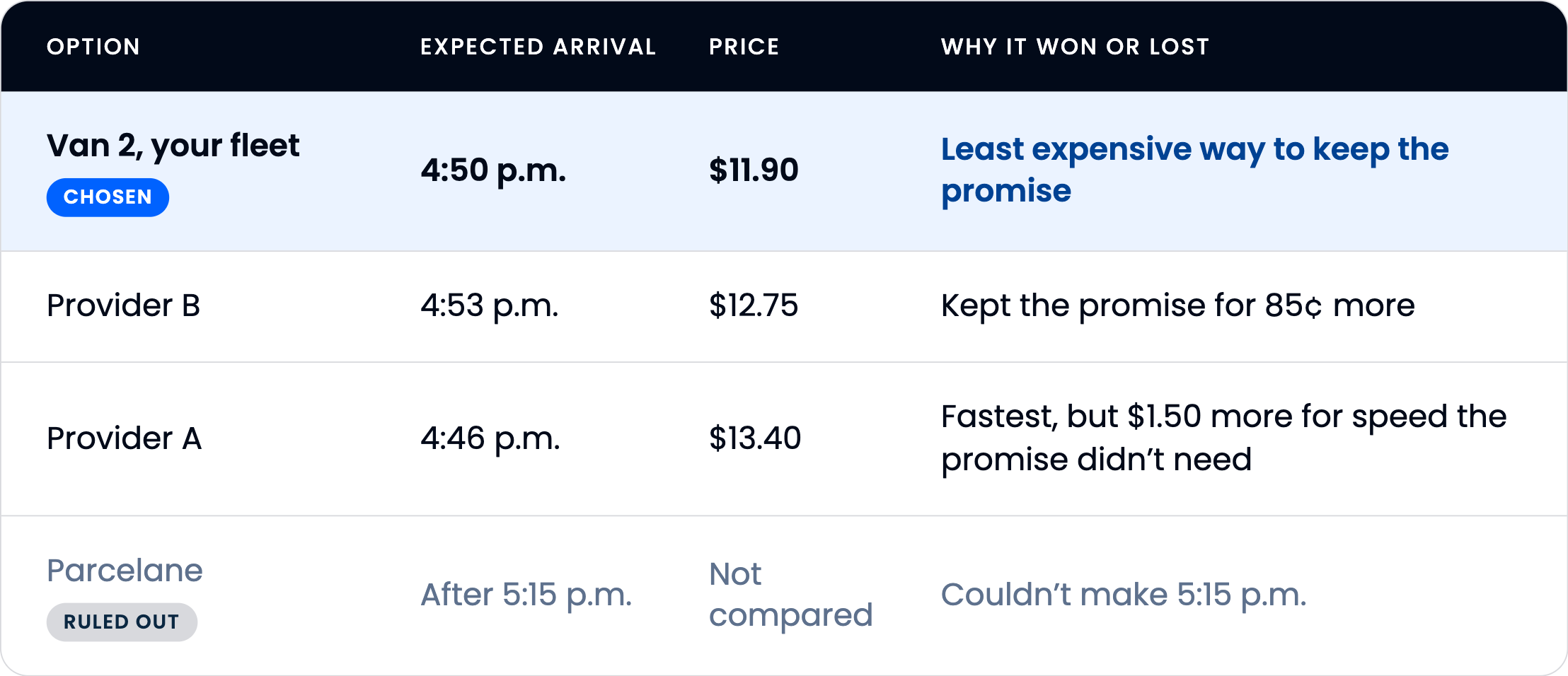
Provider A was fastest, but $1.50 is a lot to pay for speed nobody asked for, and its track record had slipped: an on-time score of 81 for 5 p.m. in rain, down from 88 after a late run on a wet Friday.
With your van in the race, a third party would have won only if the customer needed the box by 4:48 and A’s record made its 4:46 believable.
Every Entry Names Who Made the Call, Even When It Was You
Sometimes a third party wins because your team picks it.
Ten minutes before the 4:12 call, Store 12 had another order, and Burq picked Provider B at $12.75. Your team sent it to MoveCrew, another provider, for $14.10, and MoveCrew kept the promise. Its entry says, “You decided,” notes Burq’s pick would have arrived six minutes late, and grades your call in your favor.
Every entry carries that line. The 4:12 one says Autonomous: Burq acted on its own, inside your limits on price, delivery windows, and approved providers. Segment climbs one rung at a time:
1. Manual (your team decides)
2. Shadow (you decide; Burq’s pick is recorded next to yours)
3. Review (Burq proposes, you approve)
4. Autonomous
As Jake Stein, Burq’s Head of Commercial, told FreightWaves, “Our product earns your trust before fully automating.” Nobody should hand over the keys on day one, and Burq never asks for them.
Grade Each Call on What Was Known at the Time
Burq earns the keys the way a new dispatcher would: by getting calls right for the right reasons. On the 4:12 order, Van 2 pulled up a minute early, and the call was graded correct. The grade came from what Burq knew going in, though: a free van, a 5:15 promise, and the lowest-cost way to keep it.
Those facts were sealed the moment it decided. Later events, like the reroute around traffic on 9th, were filed separately, so they can’t make the call look better or worse.
Keeping the two apart matters, because hindsight is hard to resist. In a 1988 study, people rated the same decision smarter when it happened to work out, and a 692-person replication found it again. Judge every call, human or software, on what was known at the time, and the keys go to whoever keeps making good calls, rain or shine.
How Finance and Auditors Read a Decision Ledger Entry
Your ops team reads the grades. The entry’s toughest readers, though, are the CFO who asked about that third-party bill and the auditor checking the answer. Expect these questions:
- “What did this cost us?” Exactly what Burq priced it at: $11.90, 85 cents under the next-best option.
- “Why is this invoice higher than the quote?” In one Burq sample, a provider quoted $14.00, showed up late, and still billed $21.50. The record flagged the $7.50 gap against the quote.
- “Who made this call?” The entry says whether Burq acted alone or your team did. If it was you, it reads: “You decided.”
- “Could anyone change it later?” No. This entry was sealed 37 minutes before the van pulled up, and every override and rule change lands in the audit trail.
Gartner named decision governance, keeping AI decisions accountable, a top supply chain technology trend for 2026. Your auditors got there first.
Make Every Dispatch Call One You Can Check
So the next time someone asks why an order went to a third party, you won’t have to shrug. Pull up the entry and walk them through what Burq knew, what it priced, who made the call, and how it was graded. You’ll have that conversation a lot this peak season. Adobe expects $275.1 billion in U.S. online holiday sales, and your CFO will ask about the expensive ones.
That’s the conversation Burq was built for. Burq Intelligence weighs every order against the Decision Graph, picks how it moves, and writes down why. Dispatch OS runs each call at the authority you’ve granted, from Manual to Autonomous, and drops back down the moment a hard rule breaks. More than $500 million in orders have moved through Burq, and every one left a record.
Book a demo and bring the order your team still argues about. We’ll replay it and show you the entry Burq would have written.
FAQs
What is a decision graph in delivery?
A decision graph is the evidence behind delivery decisions: how every provider, van, and route has actually performed, by zone, hour, and weather. Every new order gets decided against it, and every graded result feeds back in. Burq’s holds 162 million decisions on the record.
How is a decision graph different from delivery tracking?
Tracking shows what happened to an order after dispatch. A decision graph works before it, as the performance history every order is decided against. Tracking can tell you the van was late. The Decision Ledger entry tells you whether sending it was the right call.
How does a decision graph relate to decision intelligence?
Decision intelligence is the practice of improving decisions through feedback, and a decision graph is the evidence it runs on. In delivery, that loop runs order by order: decide, record, grade, feed back. Gartner published its first Magic Quadrant for decision intelligence platforms in January 2026.
Why would an order go to a third-party provider when my own van is free?
Because a free van still has to make the promise inside its driver’s shift, carry the item, and cost less than the next option. A contract commitment, or a call from your own team, can also send the order elsewhere. The Decision Ledger entry names which one did.
How do you audit an AI dispatch decision?
Read the record written at decision time, since later reports bend to the outcome. It should show what the system knew, every option and price, and who decided. Burq seals each entry, exports the ledger as CSV, and keeps it under SOC 2 Type II and ISO 27001 controls.