.png)
Micro-Fulfillment: The Key to Faster Last-Mile Delivery in 2025
Micro-fulfillment has shifted from experiment to proven strategy, helping retailers and pharmacies cut costs, speed up delivery, and scale smarter when paired with intelligent dispatch and multi-provider networks.
Why the Last Mile Is Ripe for Reinvention
The final stretch from store or warehouse to the customer’s door has always been the costliest link in the supply chain. Now, with rising labor costs, urban congestion, sustainability pressures, and “I-want-it-now” delivery expectations, the challenge is sharper than ever.
One solution gaining momentum: micro-fulfillment — compact, tech-enabled hubs that position inventory closer to customers. But is it the silver bullet for balancing speed and cost? Let’s unpack the 2025 reality.
1. What Micro-Fulfillment Looks Like Today
Micro-fulfillment has moved from a niche experiment to a mainstream logistics strategy but its execution today looks different than it did just a few years ago.
Modern micro-fulfillment centers (MFCs) are compact, high-efficiency hubs often placed inside or adjacent to existing retail locations, grocery stores, or even underutilized urban spaces. They’re designed to store, pick, and pack products closer to customers, shrinking delivery radii and unlocking same-day or next-day fulfillment.
Key traits of today’s MFCs include:
- Hybrid automation – Many combine robotics and conveyor systems for high-volume SKUs with manual picking for slower movers or specialty items.
- Data-driven inventory placement – AI forecasting tools decide which products to store locally based on buying patterns, seasonality, and neighborhood demographics.
- Omni-channel readiness – One location fulfills online orders, supports BOPIS (buy online, pick up in-store), handles curbside pickup, and stages last-mile deliveries.
- Flexible formats – From in-store backrooms to dedicated micro-warehouses, setups scale based on available space and order volume.
- Rapid replenishment cycles – Stock turns faster, with daily or even multiple daily restocks from regional distribution centers.
Why Now?
The post-pandemic acceleration of quick-commerce expectations, think groceries in hours, prescriptions same-day, has put pressure on traditional centralized distribution. Urban congestion, labor costs, and sustainability goals have made shorter delivery distances more appealing. Add to this the integration of AI-driven orchestration platforms and businesses can now operate MFCs with far greater precision, controlling everything from routing to provider selection without manual intervention.
In short, today’s micro-fulfillment isn’t just about storing inventory closer, it’s about orchestrating local fulfillment smarter, with technology that ensures every square foot and every delivery mile is optimized.
2. Speed Gains That Move the Needle
Micro-fulfillment centers (MFCs) shorten the distance between product and customer, unlocking delivery windows that once felt impossible for many retailers.
How much faster?
- Industry benchmarks show a 30–50% reduction in delivery time when orders are fulfilled from a local MFC versus a regional distribution center.
- For high-density urban zones, some retailers are hitting sub-two-hour delivery during peak demand periods.
- Even in suburban markets, the average delivery promise has shifted from “by tomorrow” to “by tonight,” thanks to shorter last-mile routes.
Why it matters:
- Customer retention: According to Capital One Shopping, 92% of consumers factor delivery windows into their purchase decisions, and 88% say real-time tracking is critical for a positive experience.
- Cart conversion: Faster delivery times reduce cart abandonment—especially for groceries, perishables, and seasonal goods.
- Operational agility: Shorter delivery windows allow for later cut-off times, meaning businesses can accept and fulfill more same-day orders without expanding fleets.
Speed gains in action:
- A regional grocery chain using in-store micro-fulfillment cut average delivery time from 3 days to under 24 hours, increasing repeat order frequency by 18%.
- A specialty pharmacy using MFCs for cold-chain fulfillment reduced missed delivery SLAs by 40% in less than a quarter.
- Retailers offering same-day local delivery from MFCs see 25–40% higher NPS scores, translating into more referrals and repeat purchases.
Micro-fulfillment doesn’t just shave minutes off delivery, it compresses the entire order cycle, from click to customer, enabling businesses to keep pace with “now economy” expectations. When combined with intelligent dispatching, auto-rerouting, and dynamic provider selection, these speed gains scale without increasing delivery costs proportionally.
3. The Economics: Where It Pays, Where It Pinches
Micro-fulfillment can be a powerful lever for both cost savings and revenue growth but only when the economics align with your market, order volume, and fulfillment strategy. Done right, it can significantly lower per-order delivery costs while freeing up capital tied to slow-moving inventory. Done wrong, it can add complexity without delivering ROI.
Savings Potential
- Lower last-mile costs – Fewer miles traveled means reduced fuel consumption, less vehicle wear-and-tear, and fewer total driver hours. For high-volume delivery zones, the savings can be substantial—some grocers report 20–30% reductions in last-mile costs after implementing MFCs.
- Faster inventory turnover – Localized inventory moves faster, which shortens cash conversion cycles and reduces storage costs. Perishables benefit most, but even general retail sees gains when products spend fewer days sitting in back rooms or warehouses.
- Asset maximization – Existing retail square footage doubles as fulfillment space. By layering an MFC into an existing store or underutilized backroom, retailers avoid the cost of building or leasing entirely new distribution facilities.
Investment Realities
- CapEx for automation – Robotics, racking systems, conveyors, and warehouse management software require significant upfront investment. Fully automated systems can run into millions per site, while semi-automated setups still require substantial capital.
- Staffing for exceptions – Even with automation, humans remain essential for problem-solving—handling out-of-stock items, re-picking mis-scans, or managing unique customer requests. Labor savings are real, but they aren’t absolute.
- Operational complexity – Hyper-local fulfillment magnifies the impact of errors. A single picking mistake in a high-volume local hub can delay dozens of orders in that zone, eroding speed gains and customer satisfaction.
Making the Numbers Work
The sweet spot for micro-fulfillment is high-density, high-order-volume catchment areas where local demand can consistently justify the fixed costs. Retailers should model:
- Break-even order volume for each hub.
- Geographic overlap between hubs to avoid redundancy.
- SKU velocity to ensure inventory accuracy and freshness.
When the math works, micro-fulfillment can produce double-digit delivery cost reductions while increasing delivery frequency and customer retention. But when density is low or demand fluctuates wildly, those same fixed costs can quickly eat into margins.
4. 2025 Use Cases That Work
Micro-fulfillment has moved from pilot projects to proven operational strategies, with some industries pulling ahead in adoption. In 2025, the winning implementations share a common theme: pairing hyper-local inventory with intelligent technology to maximize speed, accuracy, and cost efficiency.
Grocery Chains: AI-Driven Routing Meets Local Hubs
Large grocers are embedding micro-fulfillment centers inside urban stores and pairing them with AI-powered routing systems. This combination optimizes every step—from picking to delivery sequencing—cutting last-mile costs by 20–30% while maintaining fresh and frozen quality standards. The tight geographic radius allows for multiple delivery windows per day, boosting customer loyalty and order frequency.
Pharmacies: Cold-Chain Compliance Without Fleet Expansion
Pharmacies are leveraging in-store or nearby micro-hubs to keep temperature-sensitive medications within strict compliance ranges. By fulfilling orders locally, they reduce transit times and minimize the need for specialized fleet assets like refrigerated vans. This not only preserves SLA performance but also reduces spoilage and compliance risk—critical for both patient safety and brand reputation.
Specialty Retailers: Seasonal Peaks Without Seasonal Strain
High-margin specialty retailers—think florists, electronics boutiques, and high-end pet supply brands—are turning to in-store MFCs to meet customer demand spikes. By moving fulfillment closer to the customer, they’ve slashed delivery times from 3 days to under 24 hours, even during peak seasons like Valentine’s Day, Black Friday, or pet adoption drives. The local hub model keeps service levels high without overburdening regional warehouses or carrier networks.
Emerging Example: QSR & Meal Kit Brands
Quick-service restaurants and meal kit providers are experimenting with micro-fulfillment kitchens, placing them in high-density neighborhoods to meet same-day or even one-hour delivery promises. This not only speeds up service but reduces third-party delivery fees, giving brands more control over margins and customer experience.
Across all of these sectors, the unifying driver is localized agility—the ability to respond to demand shifts, traffic patterns, and order surges in real time without adding long-haul delivery costs or warehouse bottlenecks.
5. How It Fits Into a Broader Delivery Strategy
Micro-fulfillment isn’t a magic bullet, it’s a high-impact tool that works best as part of a layered last-mile strategy. Alone, it can speed up delivery for certain zones. But combined with the right systems and partners, it becomes a force multiplier for speed, cost efficiency, and resilience.
Intelligent Dispatch Systems
Dynamic provider selection is critical for keeping SLAs tight, even when orders come from multiple fulfillment nodes. Intelligent dispatch tools analyze factors like provider availability, delivery time estimates, cost, and past performance in real time. This ensures every order—whether it’s 0.5 miles or 15 miles away—is matched with the provider best equipped to meet the promise. In a high-volume operation, this tech can be the difference between a 95% on-time rate and a 99% on-time rate.
Multiple Delivery Providers
Even the most strategically placed MFCs have coverage gaps. That’s why brands often maintain relationships with multiple delivery partners to handle areas where micro-fulfillment isn’t practical—like low-density suburbs or rural regions. This blended approach allows for zone-based routing: high-density urban areas fulfilled locally, and outlying orders handled by regional carriers or gig-based networks.
Integrated Inventory Systems
Micro-fulfillment only works if local inventory is accurate. Integrated inventory management ensures that stock levels at each MFC are updated in real time, preventing costly stock-outs and last-minute reroutes. This connection also supports dynamic order allocation—sending orders to the location that can fulfill fastest, not just the one nearest the customer.
Why It Works Best as Part of the Machine
Think of micro-fulfillment as one cog in a well-oiled logistics machine, not a replacement for your delivery network. On its own, it boosts speed and reduces cost in high-density pockets. But when it’s integrated with smart dispatch, multi-provider coverage, and accurate inventory data, it becomes a strategic advantage across your entire last-mile operation.
The result?
- Faster deliveries without overspending on fleet expansion
- Lower per-order costs in targeted areas
- The flexibility to adapt quickly to demand shifts, seasonal peaks, and market disruptions
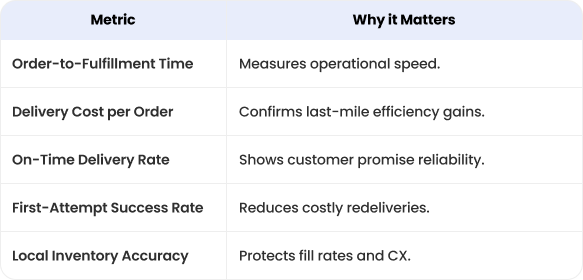
6. Metrics That Matter
To evaluate ROI, track:
The 2025 Takeaway
Micro-fulfillment is no longer an experiment, it’s a proven lever for speed, cost control, and resilience in the last mile. When paired with the right data, dispatching, and delivery network, it can boost SLAs and cut costs without adding drivers or trucks.
For brands aiming to scale delivery, delight customers, and protect margins, the question isn’t if micro-fulfillment should be in your strategy — it’s how soon you can pilot it.